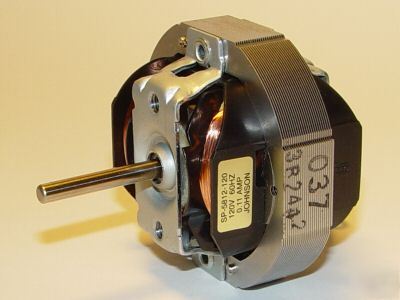
A reversible shaded-pole motor was made by Barber-Colman several decades ago. It had a single field coil, and two principal poles, each split halfway to create two pairs of poles. Each of these four "half-poles" carried a coil, and the coils of diagonally-opposite half-poles were connected to a pair of terminals. One terminal of each pair was common, so only three terminals were needed in all.
The motor would not start with the terminals open; connecting the common to one other made the motor run one way, and connecting common to the other made it run the other way. These motors were used in industrial and scientific devices.
An unusual, adjustable-speed, low-torque shaded-pole motor could be found in traffic-light and advertising-lighting controllers. The pole faces were parallel and relatively close to each other, with the disc centred between them, something like the disc in a watthour meter. Each pole face was split, and had a shading coil on one part; the shading coils were on the parts that faced each other. Both shading coils were probably closer to the main coil; they could have both been farther away, without affecting the operating principle, just the direction of rotation.
Applying AC to the coil created a field that progressed in the gap between the poles. The plane of the stator core was approximately tangential to an imaginary circle on the disc, so the travelling magnetic field dragged the disc and made it rotate.
The stator was mounted on a pivot so it could be positioned for the desired speed and then clamped in position. Keeping in mind that the effective speed of the travelling magnetic field in the gap was constant, placing the poles nearer to the centre of the disc made it run relatively faster, and toward the edge, slower.
It is possible that these motors are still in use in some older installations.


No comments:
Post a Comment