Monday, October 25, 2010

Insulator


Insulators are materials that have just the opposite effect on the flow of electrons. They do not let electrons flow very easily from one atom to another. Insulators are materials whose atoms have tightly bound electrons. These electrons are not free to roam around and be shared by neighboring atoms.

Some common insulator materials are glass, plastic, rubber, air, and wood.
Insulators are used to protect us from the dangerous effects of electricity flowing through conductors. Sometimes the voltage in an electrical circuit can be quite high and dangerous. If the voltage is high enough, electric current can be made to flow through even materials that are generally not considered to be good conductors. Our bodies will conduct electricity and you may have experienced this when you received an electrical shock. Generally, electricity flowing through the body is not pleasant and can cause injuries. The function of our heart can be disrupted by a strong electrical shock and the current can cause burns. Therefore, we need to shield our bodies from the conductors that carry electricity. The rubbery coating on wires is an insulating material that shields us from the conductor inside. Look at any lamp cord and you will see the insulator. If you see the conductor, it is probably time to replace the cord.

Recall our earlier discussion about resistance. Conductors have a very low resistance to electrical current while insulators have a very high resistance to electrical current. These two factors become very important when we start to deal with actual electrical circuits.

Conductor

Do you remember the copper atom that we discussed? Do you remember how its valence shell had an electron that could easily be shared between other atoms? Copper is considered to be a conductor because it “conducts” the electron current or flow of electrons fairly easily. Most metals are considered to be good conductors of electrical current. Copper is just one of the more popular materials that is used for conductors. In physics and electrical engineering, a conductor is a material which contains movable electric charges. In metallic conductors, such as copper or aluminum, the movable charged particles are electrons. Positive charges may also be mobile in the form of atoms in a lattice that are missing electrons, or in the form of ions, such as in the electrolyte of a battery.

Other materials that are sometimes used as conductors are silver, gold, and aluminum. Copper is still the most popular material used for wires because it is a very good conductor of electrical current and it is fairly inexpensive when compared to gold and silver. Aluminum and most other metals do not conduct electricity quite as good as copper.

Monday, October 11, 2010

Shaded-pole motor

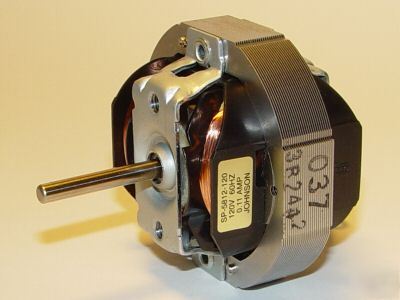
A common single-phase motor is the shaded-pole motor and is used in devices requiring low starting torque, such as electric fans  or the drain pump of washing machines and dishwashers or in other small household appliances. In this motor, small single-turn copper "shading coils" create the moving magnetic field. Part of each pole is encircled by a copper coil or strap; the induced current in the strap opposes the change of flux through the coil. This causes a time lag in the flux passing through the shading coil, so that the maximum field intensity moves across the pole face on each cycle. This produces a low level rotating magnetic field which is large enough to turn both the rotor and its attached load. As the rotor picks up speed the torque builds up to its full level as the principal magnetic field is rotating relative to the rotating rotor.

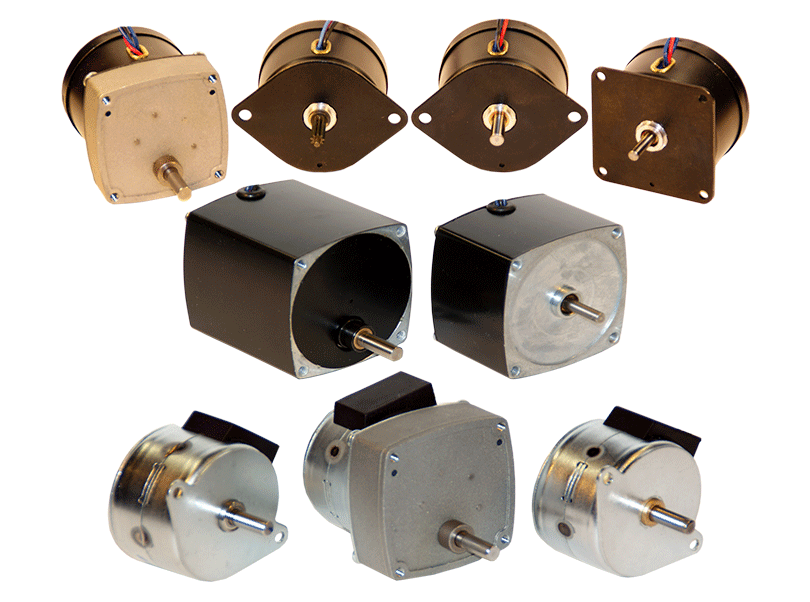
A reversible shaded-pole motor was made by Barber-Colman several decades ago. It had a single field coil, and two principal poles, each split halfway to create two pairs of poles. Each of these four "half-poles" carried a coil, and the coils of diagonally-opposite half-poles were connected to a pair of terminals. One terminal of each pair was common, so only three terminals were needed in all.

The motor would not start with the terminals open; connecting the common to one other made the motor run one way, and connecting common to the other made it run the other way. These motors were used in industrial and scientific devices.

An unusual, adjustable-speed, low-torque shaded-pole motor could be found in traffic-light and advertising-lighting controllers. The pole faces were parallel and relatively close to each other, with the disc centred between them, something like the disc in a watthour meter. Each pole face was split, and had a shading coil on one part; the shading coils were on the parts that faced each other. Both shading coils were probably closer to the main coil; they could have both been farther away, without affecting the operating principle, just the direction of rotation.

Applying AC to the coil created a field that progressed in the gap between the poles. The plane of the stator core was approximately tangential to an imaginary circle on the disc, so the travelling magnetic field dragged the disc and made it rotate.

The stator was mounted on a pivot so it could be positioned for the desired speed and then clamped in position. Keeping in mind that the effective speed of the travelling magnetic field in the gap was constant, placing the poles nearer to the centre of the disc made it run relatively faster, and toward the edge, slower.

It is possible that these motors are still in use in some older installations.

Resistance start motor

A resistance start motor is a split-phase induction motor with a starter inserted in series with the startup winding, creating capacitance. This added starter provides assistance in the starting and initial direction of rotation.

Permanent-split capacitor motor

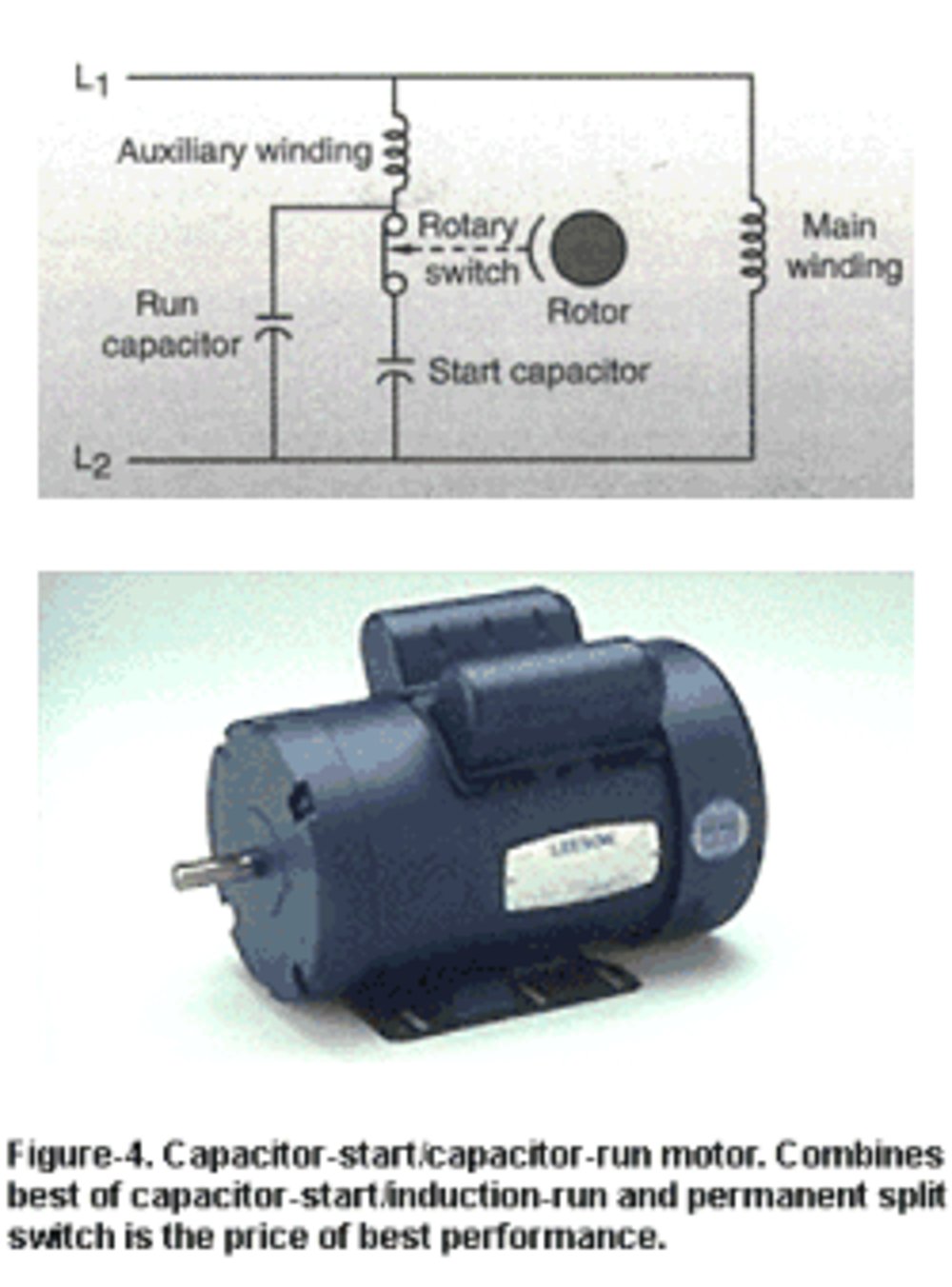
Another variation is the permanent-split capacitor (PSC) motor (also known as a capacitor start and run motor).This motor operates similarly to the capacitor-start motor described above, but there is no centrifugal starting switch, and what correspond to the start windings (second windings) are permanently connected to the power source (through a capacitor), along with the run windings. PSC motors are frequently used in air handlers, blowers, and fans (including ceiling fans) and other cases where a variable speed is desired.

A capacitor ranging from 3 to 25 microfarads is connected in series with the "start" windings and remains in the circuit during the run cycle. The "start" windings and run windings are identical in this motor, and reverse motion can be achieved by reversing the wiring of the 2 windings, with the capacitor connected to the other windings as "start" windings. By changing taps on the running winding but keeping the load constant, the motor can be made to run at different speeds. Also, provided all 6 winding connections are available separately, a 3 phase motor can be converted to a capacitor start and run motor by commoning two of the windings and connecting the third via a capacitor to act as a start winding.

Capacitor start motor

A capacitor start motor is a split-phase induction motor with a starting capacitor inserted in series with the startup winding, creating an LC circuit  which is capable of a much greater phase shift (and so, a much greater starting torque). The capacitor naturally adds expense to such motors. 


“Split phase” mortors

One type of induction motor, which incorporates a starting device, is called a split-phase induction motor. Split-phase motors are designed to use inductance, capacitance, or resistance to develop a starting torque. The principles are those that you learned in your study of alternating current.

Induction in motor

An induction motor is a type of alternating current motor where power is supplied to the rotor by means of electromagnetic induction.

An electric motor turns because of magnetic force exerted between a stationary electromagnet called the stator and a rotating electromagnet called the rotor. Different types of electric motors are distinguished by how electric current is supplied to the moving rotor. In a DC motor and a slip-ring AC motor, current is provided to the rotor directly through sliding electrical contacts called commutators and slip rings. In an induction motor, by contrast, the current is induced in the rotor without contacts by the magnetic field of the stator, through electromagnetic induction. An induction motor is sometimes called a rotating transformer because the stator (stationary part) is essentially the primary side of the transformer and the rotor (rotating part) is the secondary side. Unlike the normal transformer which changes the current by using time varying flux, induction motors use rotating magnetic fields to transform the voltage. The current in the primary side creates an electromagnetic field which interacts with the electromagnetic field of the secondary side to produce a resultant torque, thereby transforming the electrical energy into mechanical energy. Induction motors are widely used, especially polyphase induction motors, which are frequently used in industrial drives.

Induction motors are now the preferred choice for industrial motors due to their rugged construction, absence of brushes (which are required in most DC motors) and—thanks to modern power electronics—the ability to control the speed of the motor.